We all know first-round picks are more valuable in the NFL. Here is some data to back it up.

With Super Bowl Sunday fast approaching it marks the grand end to the NFL season, a celebrity showcase with a side of football. But it also marks the start of another season in the NFL, the long milking of its greatest content-cow, the first round of the NFL Draft. Months of hype, mock drafts, player evaluations and millions of views lead up to 32 eagerly anticipated picks. And with it comes a ton of showmanship. A grand stage, fireworks and.. caps?? With a single pick the destiny of your franchise could change. Of course, there are 6 other picks in the following rounds but its the first round pick that matters. As a non-native NFL watcher, I never quite understood why the first round was so hyped (I came to the sport much later in my life, thanks to Colin Kaepernick’s demolition of the Jacksonville Jaguars In London). I knew first round players were generally better of course but I always found myself asking; is there really that much difference between a first round and second round pick? After all, the GOAT was selected in the 6th. I decided to look at the numbers. Shout out to the good folk who maintain the nflverse, one of the best open sports data sources on the internet.
The Metrics
First we need to define what a successful pick looks like, is it Super Bowl appearances? Games Played? Pro Bowls? All Pros? I decided that Pro Bowls would be most suitable for a few reasons. Being selected as one of the top 80 something players in the league is a success by any measure, and I wanted success to be broad enough so as to not limit myself to just the elite. Secondly, I will be limiting the players drafted to pre 2020, as players drafted after this point will still be early in their NFL careers.
The Analysis
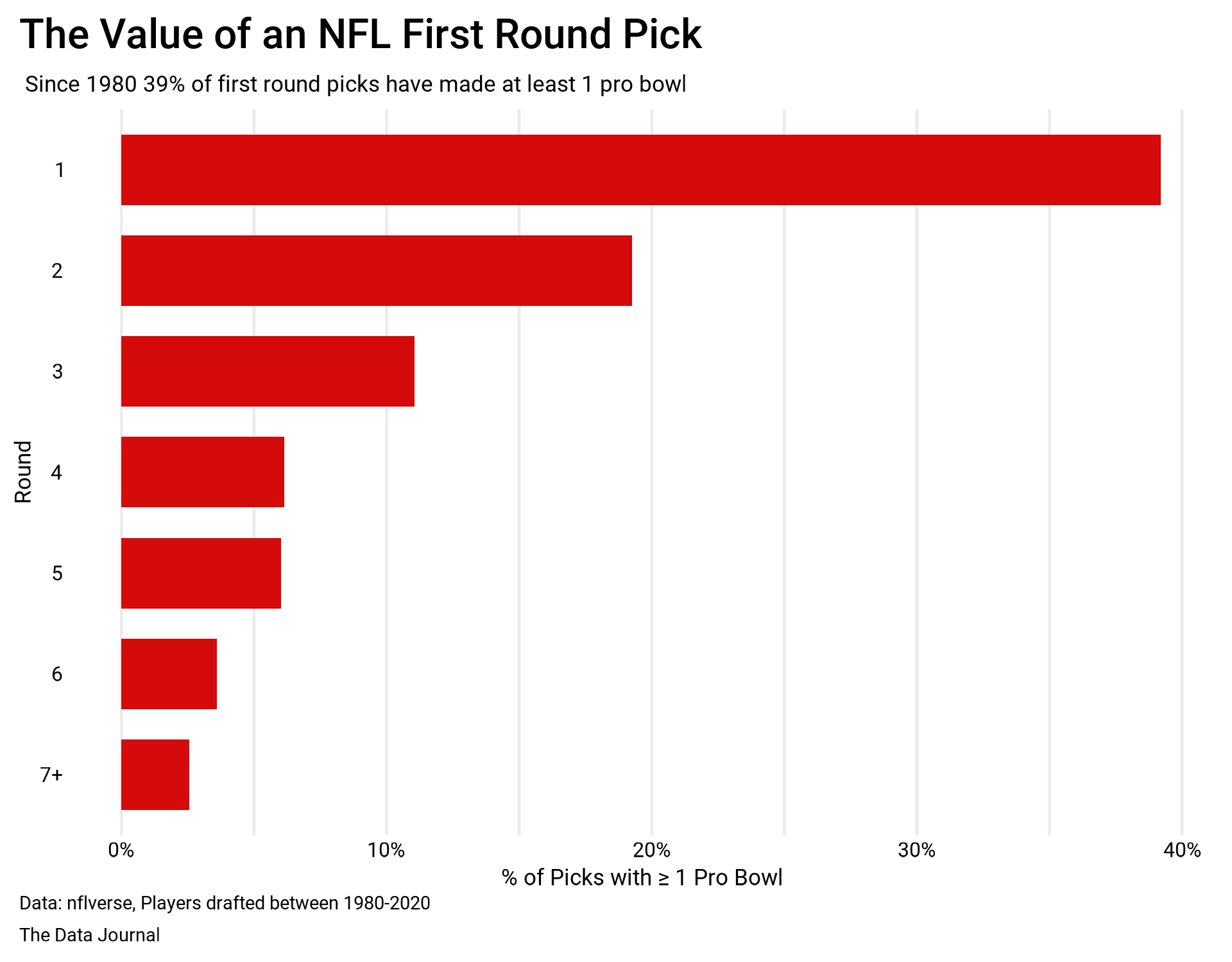
The value of a first round pick had immediately become obvious. A first round pick is almost twice as likely to make at least 1 pro bowl in their career than a second round pick, this discrepancy just grows as the rounds progress. Quite quickly I’d proved what I set about to but at this point I was invested enough to continue investigating.
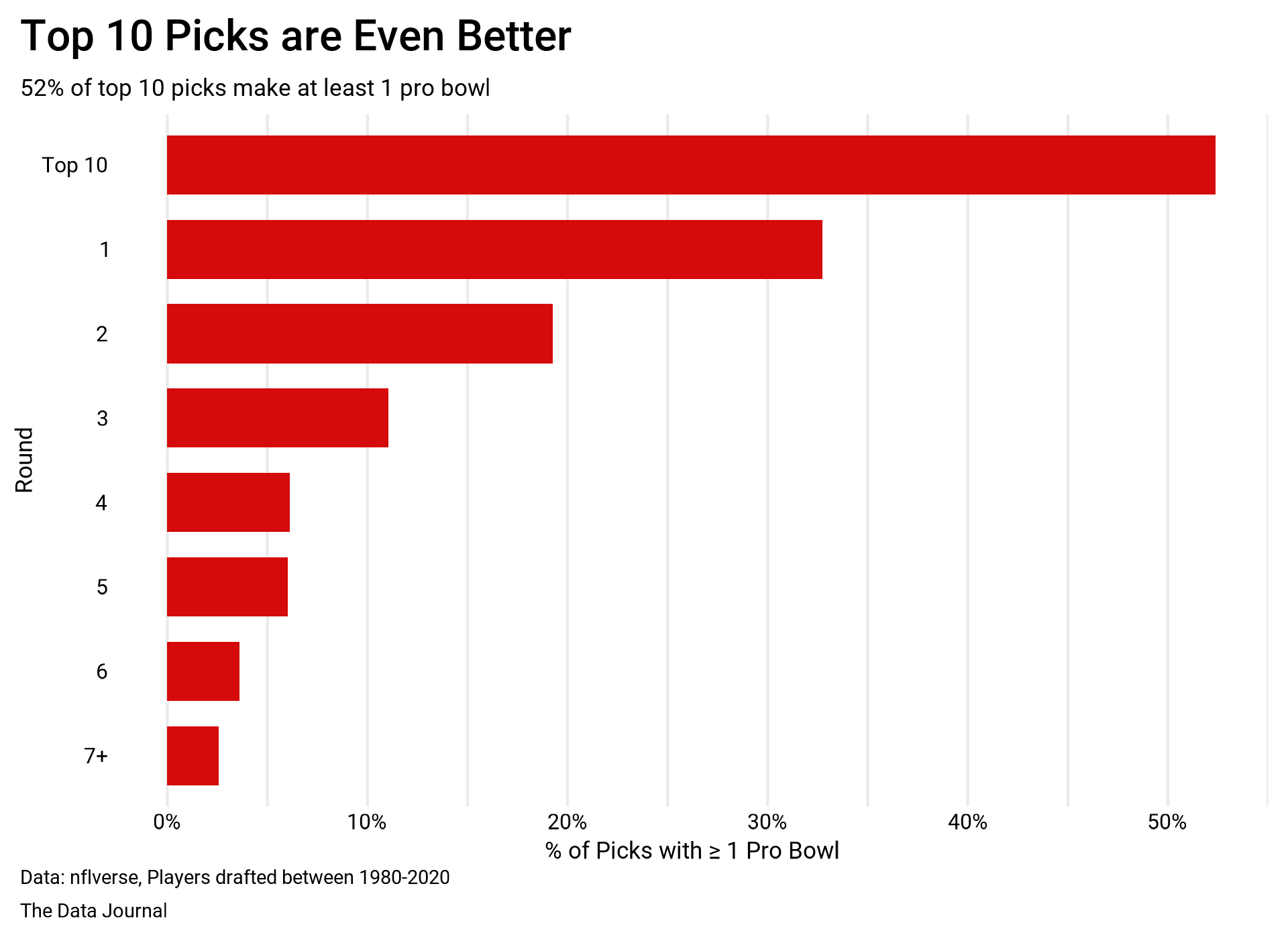
A great deal of ink, air time and debate is spent focusing on the top 10 picks. After all, these are the best of the best coming out of college. And the data backs this up with 52% of top 10 picks between 1980 and 2020 making at least one pro bowl in their careers. But this also shows that evaluations are an imperfect science, whilst analysts and NFL backrooms are clearly doing something right in their draft evaluations it still remains true that almost half of top 10 picks don’t quite live up to the expectation. Has this improved over time? To account for the high year-to-year variance of the NFL Draft, I used a five-year rolling average to evaluate this.
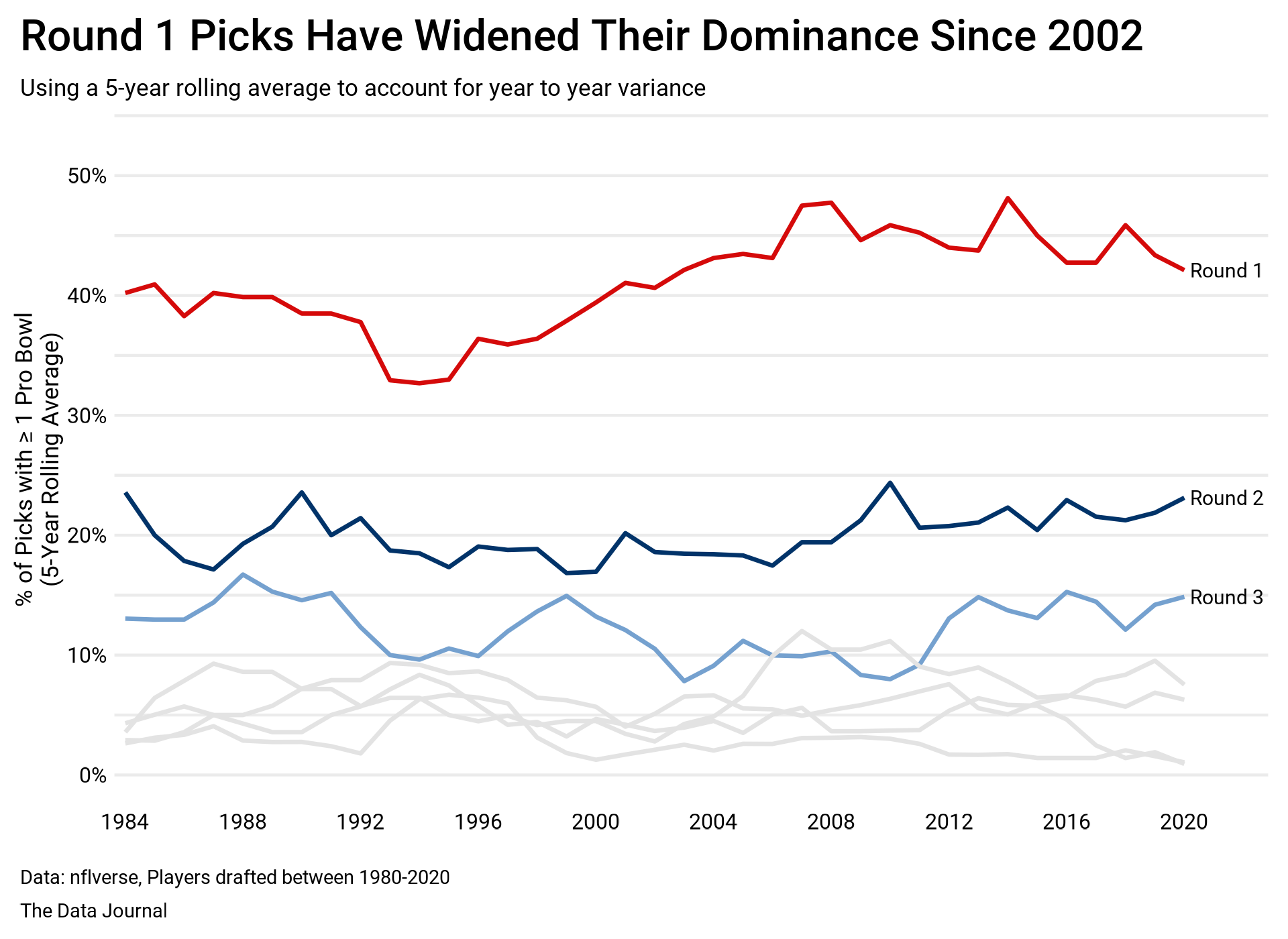
And the answer? A little. Whilst teams have certainly improved at evaluating first round talents since 1980, it is only a small improvement, with the rolling average rising by +5% since 1980. It seems that despite all of the improvements in data, scouts and analysis teams have only mustered a few percentage points improvement over their first round scouting in the 80s and have shown little to no improvements in day 2 and day 3 picks at all. The first round premium however has persisted all along and even widened since 2002, further increasing the value of a first round pick.
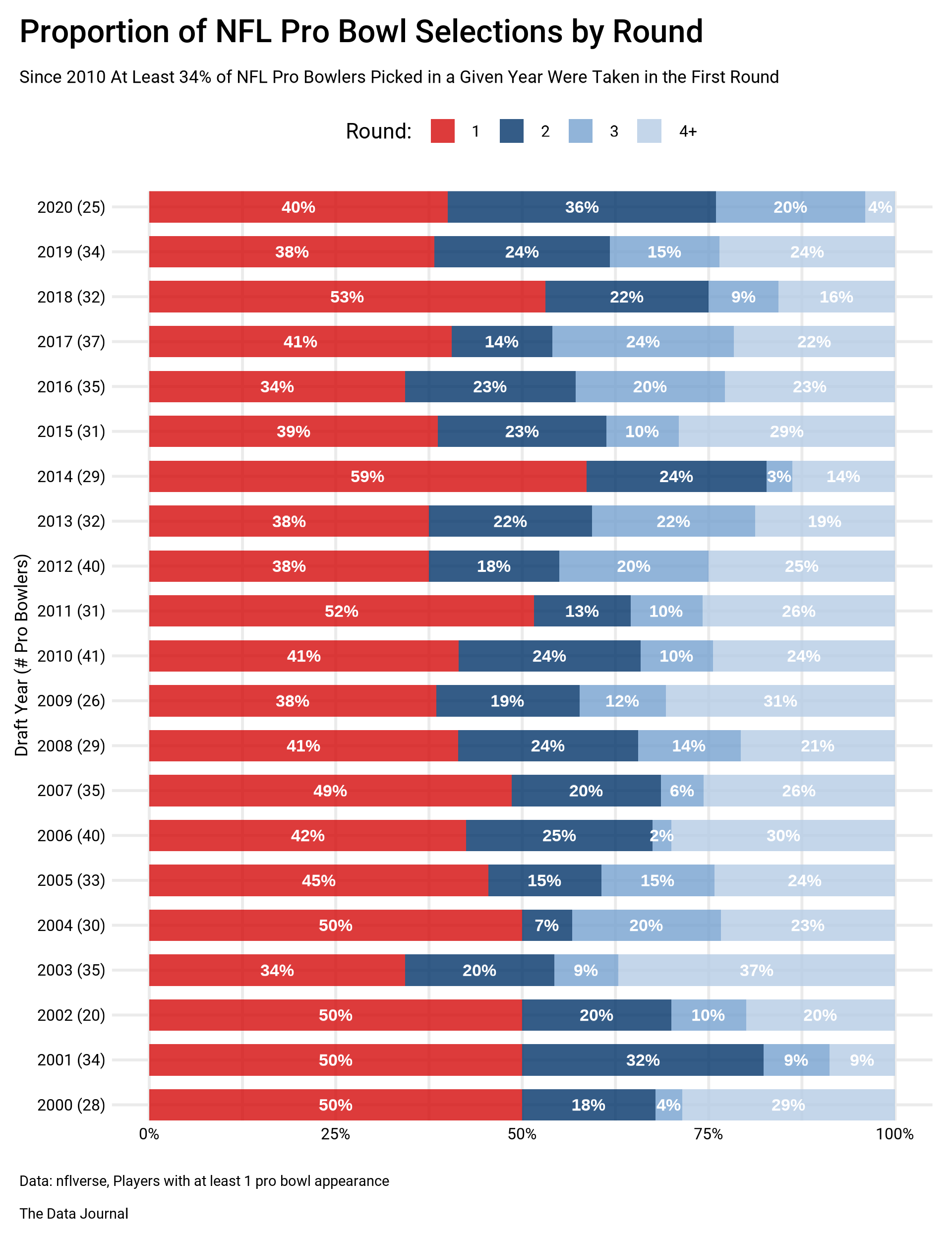
When we look at just the Pro Bowlers picked in a given draft year we see that, consistently, more than 30% often more than 40% of of them are selected in the first round. But this also means between 50%-60% of players that make the pro bowl in a given draft year are selected after the first round, so whilst there is certainly a huge advantage, there is still plenty of talent to select from in later rounds. At this point I’d pretty comprehensively proven that a first round pick is worth all of the hype. It comes as no surprise of course, but for what positions groups does it come with the largest premium?
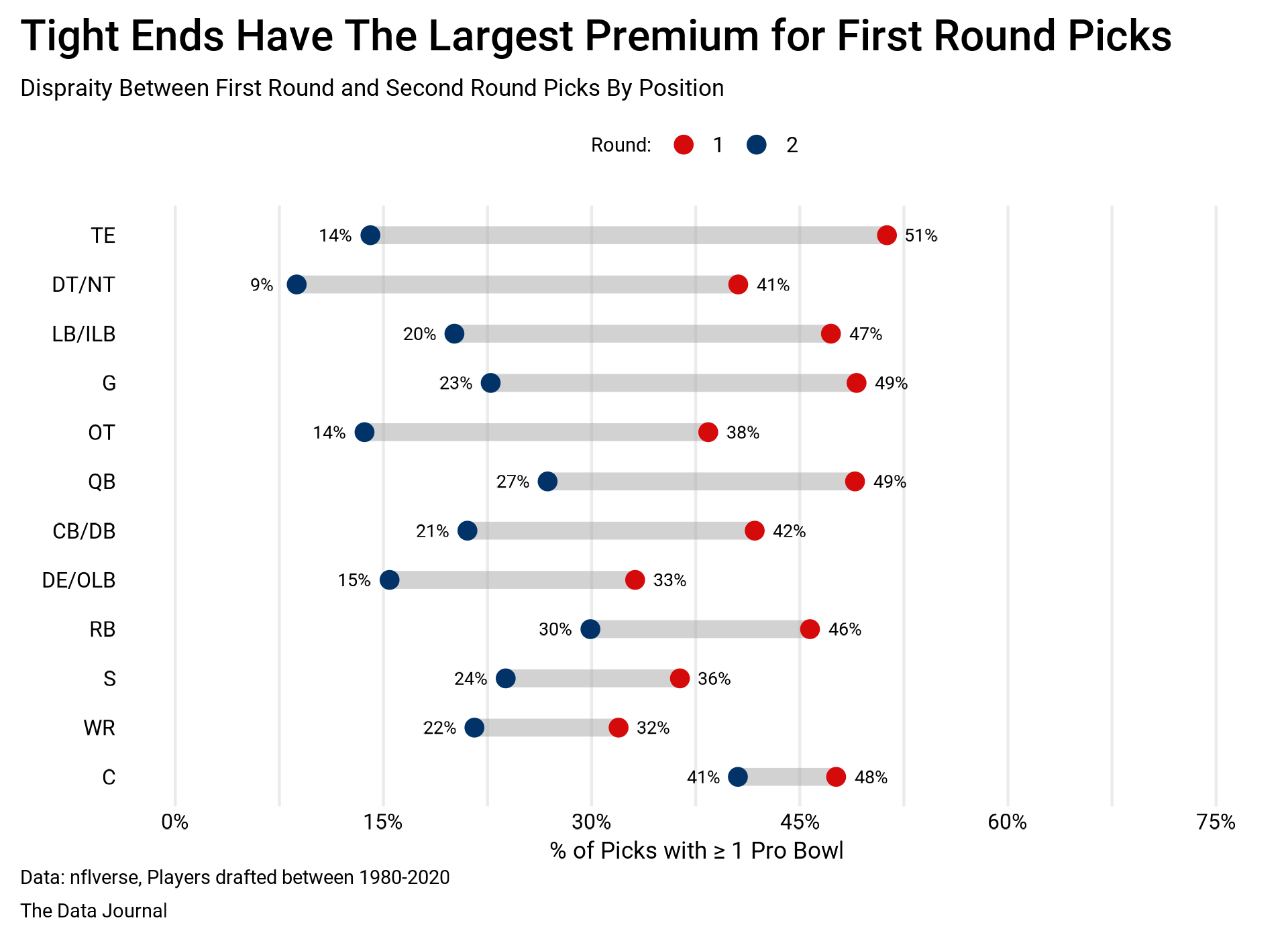
It’s an old adage of the NFL, that games are often won and lost at the line of scrimmage. And it seems that a first round investment into these positions yield a much better rate of return than a second round investment. I really expected quarterbacks to have a much higher premium, more than any other position group a QB is marked with their draft position. And there is a significant premium of course, with 46% of QBs taken in the first round making a Pro Bowl compared to just 25% for those taken in the second. But I didn’t expect Tight Ends to have the highest premium. A first round tight end is a whopping 37 percentage points more likely to make a pro bowl compared to one taken in the second. In hindsight this makes sense, Tight Ends have a huge bar to clear to be good enough for a first round grade, this also results in a comparatively smaller sample size of tight ends taken in the first as only elite prospects ever make it.
So I’d proven that first round picks and all of the grandeur and theatrics that come with the first round of the NFL draft were more than warranted. Not only are these players considerably more likely to have success in their careers, but for certain position groups not taking a first round grade, where one is available, can be actively doing a disservice to your franchise.
Its not that simple of course. Drafting is an imperfect science. Teams can select not-quite good enough players high due to a thin draft class for necessary positions, first round grade players can drop due to injury or character concerns and, in some cases, a first overall pick may just decide they love cheeseburgers more than the game of football. So, whilst a first round pick is generally a teams best bet at selecting pro bowl caliber players, by no means is it the only place to find these players. As a little fun aside I decided to see which teams select the most pro bowlers outside of the first round.
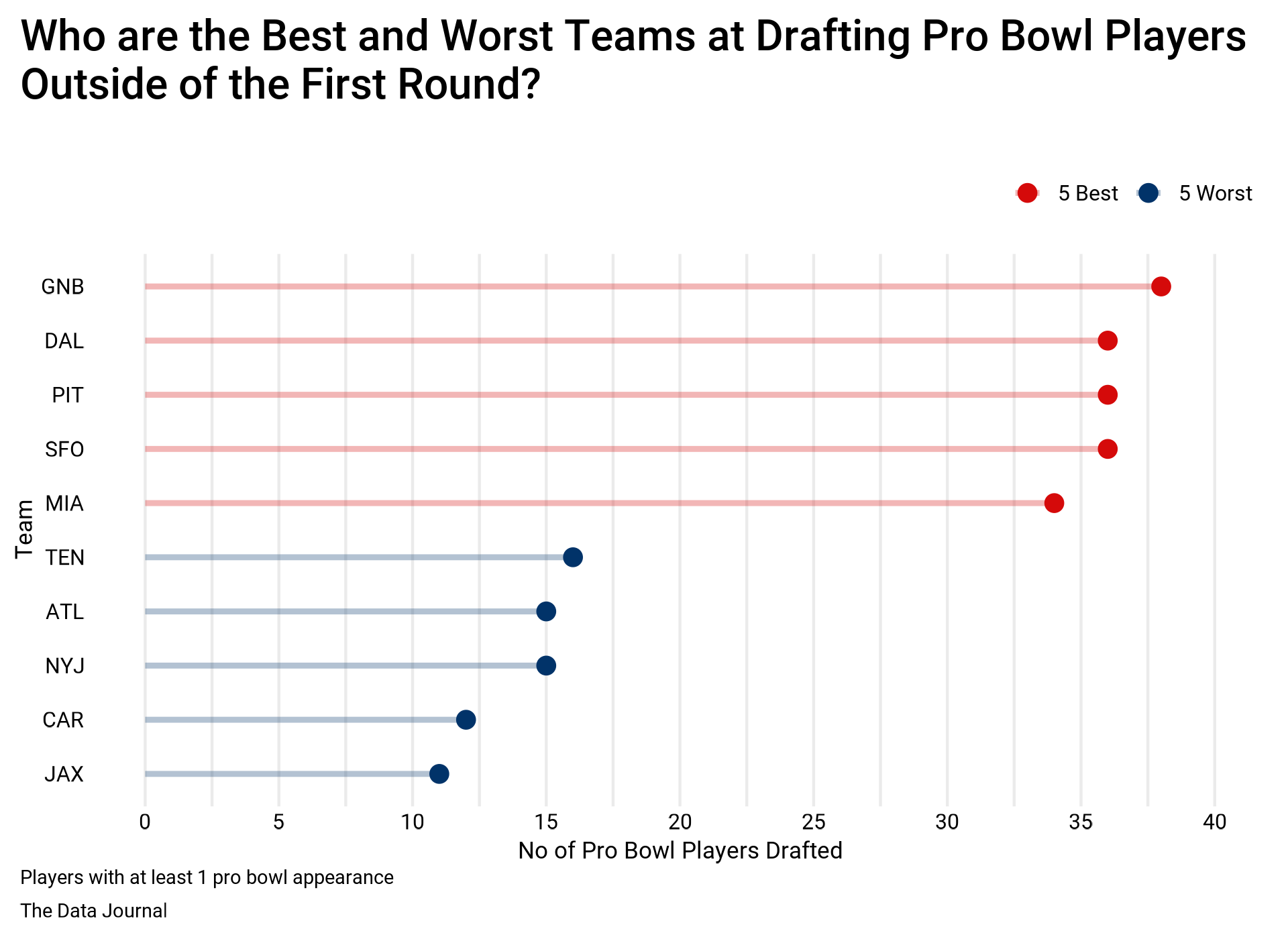
Funnily enough it seems stable franchises, with a history of good QB play and winning are able to select the most pro bowlers outside of the first round. These teams usually select later in drafts (and supposedly have worse players to select from) yet their players succeed at a higher rate. Either these teams have a magic touch when it comes to evaluating late round picks or where you land matters for a player. I’m inclined to pick the latter.
Data: draft picks from the nflverse